Sofia Almeida
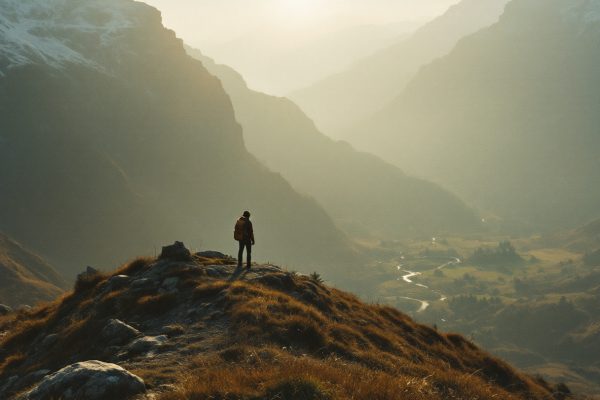
As a solo traveler, there is a unique problem for photography: how to take good photos of yourself? After 11 years of traveling around the world (solo, except for once), I have refined a few techniques to share here. I use these for all solo shots, in order to avoid using a selfie stick, or getting people to point and shoot at me (which rarely results in a good photo, anyway). Here is how I do it.
Phone timer with stable surface beats handheld
Use a phone timer: For the sharpest solo travel photos set up your phone on a stable surface with a solid background using a timer. This can be a wall, railing, or rock. Open up your camera app and adjust the frame so that the location will be at the bottom two-thirds of the photo, and your body at the top third. This makes for a ‘me here’ style of photo, rather than ‘me in front of a wall’. Use the timer to take 10 second delayed shots. These can be set to burst mode, taking 5 to 10 photos in total. I find the iPhone and most Androids are set to burst mode by default, which is great for taking loads of shots in a short amount of time. The best of which can be shared with friends and family back home.
Light is more important than equipment
I have found that phone photos taken at golden hour are vastly superior to those shot during the middle of the day. As a traveler, I generally aim to be at a location 45 minutes prior to sunset in order to shoot the hour after sunrise and the hour before sunset. The resulting shots are of soft, warm light that can flatter the subject and their surrounding environment. Note that overcast days can also be good for shooting solo portraits, as the resulting diffuse light can help remove harsh shadows from the image and mean that the photographer doesn’t have to worry about squinting in bright sunlight.
Tripods you actually carry
Travel tripods are inherently limited in use due to their size. That said, all tripods that travel can be used to some extent with a bit of creativity. In my case I much prefer the smaller phone tripods over full-size traditional models, as they can be used in more locations. Specifically I find that my GorillaPod 3.5 (5 inches long, 4 oz) does an excellent job wrapping around railings, fence posts, odd-shaped branches, etc., making it the perfect travel tripod for me. It is dramatically more versatile in the field than my full-size tripod for the simple reason that it can use any stable surface to support it. Smaller tabletop-style models (e.g. the Manfrotto Pixi, 8 oz) do quite well for me on flat surfaces and allow for really quick setup for timer shots, but they aren’t as versatile as the GorillaPod for odd situations. As with most things in life, the key is to decide which model will travel with you daily and which will travel with you for photography focused trips. While the latter model may be better for specific needs, the former will see far more use. I can vouch for this as I have went back and forth on this topic for the past 11 years or so and currently I am firmly entrenched in the GorillaPod camp.
When to ask a stranger and how
On the other hand, I have often had to ask complete strangers to take my photo. Sometimes they can even produce an amazing shot. It all depends on the stranger that you pick. I would generally go for someone who has recently taken a photo of themselves or their group of friends, someone who seems to know their way around a camera or who is even lugging around a proper camera as opposed to just a phone. I try to approach them in a nice way and say something like, “Excuse me, can you take a photo of me with this place behind me?” and then I point out exactly where the place is that I want to be in the background. If the first photo that they take is absolutely terrible then I ask for another one politely and then I move on. I have found that this approach generally results in the best photos for solo travelers.
Phone settings that produce sharable photos
Unless otherwise specified your iPhone is set up incorrectly for your traveling. HDR on should be turned off for all action shots (like a market, ferry dock, children at play, etc.) and for shots with high contrast (like inside then outside) as it blurs dynamic scenes and then averages them back together to produce an uninspired photo. Landscape shots however have a high dynamic range and thus should have HDR on. Ultra-wide angle (0.5x) is your best bet for an environmental portrait shot in order to capture the surrounding area to frame the photo in. Using the 1x main lens is best for shots up close where the traveler can take better care in their framing. The 2x and 3x zooms of a phone do poorly in quality once they produce when cropped down. Traveling Portrait mode (cinematic mode, etc.) will be your best bet for shots of people in really crowded or busy environments where the background will blur really well.
What I would tell a first-time solo traveler
Start in an easy country for first-time solo travelers (Japan, Portugal, Spain, Mexico, Vietnam) and work your way up from there. On your first solo trip you shouldn’t also be figuring out a really difficult country. Stick to a few cities instead of moving around a lot, once you get the hang of traveling solo on your own. The second week in a location is where you really start to connect with people and form routines, which is the core of any amazing solo travel experience. And yes, some days will be lonely. But that’s the experience and the travel, not a failure of your trip. It teaches you what you had and what you really want.